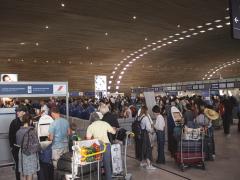
TECHNOLOGY that supports customer relationships is where the next wave of innovation will be seen, said Carolyn Viens from IBM Travel Related Services when sketching a scenario of the travel experience of the future to delegates attending last month's Eurhotec 2001 in Paris, the International Hotel & Restaurant Association's (IH&RA) 6th European Hospitality Technology Conference.
WAP phone that allow remote check-in and in-flight movie selection before arrival at the airport; in-flight video-conferencing with colleagues on other planes; voice-activated GPS equipment rental cars; hotel scanners that identify the guest upon on arrival allowing instant key delivery and customised information on the guestroom TV; automatic transfer of hotel e-folio to the guest's corporate expense report; WAP phone notification of flight re-scheduling information to the traveller, his/her home and office and bio-metric scanning to pass Customs at the airport.
"This could be happening sooner than anticipated," said Viens, "as the technology on which they are based is already being experimented with. For example, IBM is currently testing a 'travel card' that will allow a personal digital device to receive a boarding card electronically within ten seconds of check-in.
According to Michael Hartmann, director of industry marketing hotels for Siemens ICN, the Mobile Internet will be the 'Next Big Thing' to impact the business world.
"With the proliferation of non-PC Internet devices, business travellers are no longer tethered to a computer to access the Web. The challenge for hoteliers will be to spot alternative revenue opportunities because if a guest has mobile Internet access, he won't use the hotel infrastructure.
"For example, with a wireless LAN, the hotel could play the role of an Internet Service Provider and provide a portal - earning a percentage of the transaction fee."
To be successful, he emphasised, hotels must be 'embedded' in strategic partnerships, for example with airports, rail networks and other providers in the travel chain.
Inter-connectivity of in-room devices was tipped as the technology development of the future by VingCard Elsafe's VP of marketing, Erik Olsen.
He said it is only a matter of time before air-conditioning, locking, minibar, TV, phone, safe and energy systems will be connected via a central server to key hotel departments, such as front desk, kitchen and
engineering. This type of connectivity could, for example, make it possible to alert guests checking-out that they have left passports and tickets in the room-safe. It could also be used to ensure that, in the event of a fire, guest room doors are simultaneously opened and evacuation instructions are issued.
However, delegates made the following observations:
* Technology will only 'stick' if it is customer-centric and if it helps the hotel to improve guest retention
* The speed of the evolution of M-business will depend on the user-friendliness of the devices involved
* Hotels that take the outsourcing option (e.g. using ASPs) will need to build strong relationships with their service providers
* There is a pressing need not only for greater staff training but more guest education on what technology can do.
(Elizabeth Sheridan)
IH&RA tech think tank outlines challenges and opportunities
Comments | 0
© Now Media. This content is protected by copyright and may not be adapted or republished. If you would like to discuss cooperation opportunities, please contact: editor@travelnews.co.za.