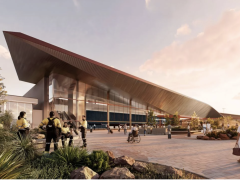
ONCE development plans are in place, South Africa's third Word Heritage Site, the Cradle of Humankind, will become a major international tourist attraction, with Mrs Ples - a 2,5 million year old human fossil skull - in a pivotal role to "seduce" tourists to Gauteng and the North West Province. This according to Mary Metcalfe, Gauteng provincial minister for Agriculture, Environment and Land Affairs, who yesterday announced that the Tourism Master Plan for the region - one of ten Blue IQ development projects earmarked for funding by the Gauteng government - had been completed and would be presented for public comment. The government has committd R150m to this project. Stakeholders attended a public meeting at Lanseria Airport in Randburg last night where the master plan document was presented. "This 47 000 hectare site plays an incredibly important role in tracing the origins of humankind as 60% of everything we know about the origin of humans was discovered here. Central to that is Mrs Ples who was discovered in 1947 by Dr Robert Broom and is believed to be the most complete skull ever found of the early species of humankind. Building on the same drawing power that the so-called 'Mandela-factor' has in attracting tourists to Robben Island, Mrs Ples, too will be marketed as an icon - a 'must-see' attraction." Metcalfe stressed that in order to attract more than a limited number of "special interest" tourists to the region, the Tourism Master Plan calls for a comprehensive tourism "experience", recommending that tourism facilities offer a wide range of interactive learning opportunities and recreational spaces. A network of interpretive facilities will be created, opening up the site to the North West Province, as well as Johannesburg, Pretoria, Magaliesberg, Hartebeespoortdam and Krugersdorp. "A gateway to the Cradle will be created with the construction of a core development, an Interpretation Centre, to be built at Mohale’s Gate. According to Metcalfe, plans for the Interpretation Centre include a visitor information point, transport hub, field and site support facility, outdoor amphitheatre, restaurant, retail and food outlets, a conference centre and an orientation and exhibition centre. She says a primary fossil homonid interpretation centre is also on the cards for the adjacent Sterkfontein site. Other development proposals include an upgrade of some of the roads running through the Cradle of Humankind World Heritage Site (COHWHS), craft centres, visitors centres, accommodation facilities, hiking, biking and horse trails. Signage and marketing are also highlighted as priorities of the Master Plan. Michael Worsnip, programme manager of the COHWHS, told TNN that the project will be implemented by the end of the year. "We hope to have at least some of the tourism facilities open by September next year, so we can showcase our plans to Earth Summit delegates." (Adéle Mackenzie)
Mrs Ples embraces new role as tourism "seductress"
Comments | 0
© Now Media. This content is protected by copyright and may not be adapted or republished. If you would like to discuss cooperation opportunities, please contact: editor@travelnews.co.za.