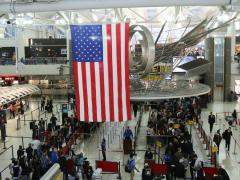
As the European summer travel season approaches, the EU’s Entry/Exit System (EES) is expected to cause major delays at airport border controls, with agents already reporting delays of more than an hour.
“A few of our passengers have been affected. Some have been able to breeze through whilst others have had delays of about an hour,” said Carla Vickers from French and Italian Excursions. She said Portugal and Italy were experiencing the delays.
EES became fully operational on April 10, with some travellers reporting waiting times of two to three hours.
At the beginning of the year, the EU announced measures to give Schengen Area countries more flexibility in implementing EES during the busy summer season. However, delays still occurred despite these measures.
Airline and airport associations warned that if challenges with the system were not addressed, travellers could expect delays of up to four hours at border controls during the peak summer period.
“If it is already affecting queues in April and May, which are significantly lower volumes than the peak summer travel months, it’s going to be a problem in June, July, August and September. It will be even more congested at arrival and departure counters,” said Chrissa Karanastasis, Luxury Cruise and Travel Specialist at The Travel Concierge.
Missed connections
Last week around 150 Ryanair passengers at Toulouse Airport missed their flight to London Stansted and in April around 100 easyJet passengers missed their flight from Milan Linate to Manchester. The delays were linked to congestion at border checks due to EES.
“I am suggesting passengers allow for an extra hour over and above the usual on departure from Europe. On arrival, I am suggesting they avoid pre-purchasing onward trains and transfers or close flight connections. You just don’t know how long it will take until you are in the queue,” said Vickers.
Karanastasis is advising clients to check in for international flights from the EU at least three to four hours prior to departure, and for flights within the EU a minimum of three hours before departure. She said cruise passengers should also be aware of the delays.
“Disembarking cruise passengers would need to ensure they do not book onward flights too soon after their scheduled disembarkation time.”
They should also make sure their arrival flight does not clash with their cruise departure time. “Cruise transfers and cruise ships cannot wait indefinitely if a passenger is delayed at the airport. I advise all travellers going into and out of the EU that this is the situation and they need to allow extra time for departure and arrival flights,” said Karanastasis.
Repeated registration
Despite the EU stating that travellers will only need to complete the process once, with stored data then used to record future entries and exits, Jenny Kutlu, Owner of JMC Travel, said she had to register and submit data on two separate occasions.
Kutlu experienced delays at passport control in Greece and Finland on separate trips, with processing, including facial scans and fingerprint scans, taking around an hour in each country.
“One would have thought that once it was done, it would not be necessary to do it again. Does the system not store data? So, when your passport details are scanned does it not come up with all the previous data captured or it is like a check-in system?” questioned Kutlu.