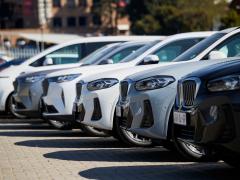
THE possibility that e-tolls
could be scrapped in
the near future might be
welcome news to motorists in
Gauteng but will pose some
hurdles for the car-rental
industry.
The ANC in Gauteng recently
publicly rejected e-tolls in
the province during a threeday
elective conference,
a development that has
been welcomed by Wayne
Duvenage, OUTA chairperson.
He says now that the Gauteng
ANC has joined the protest,
things could move more
quickly. “The e-toll bill was
opposed by every political
party in Parliament, except the
ANC, who used their numbers
to force the issue. Now that
the ANC has turned against
the scheme, this factor cannot
be ignored.”
Sherl Camera, Hertz gm of
business development, says,
however, that scrapping e-tolls
will have consequences for the
car-rental industry. She says
Hertz incurred significant costs
to prepare the company for
e-tolls in terms of compliancy,
administration, technical
and in-house systems
and IT developments. The
company also had to up-staff
to cope with the additional
administrative workload.
She says, should a decision
be taken to discontinue
e-tolling, the investment that
Hertz has made to make
e-tolling a working reality could
not be recouped.
“While it would take some
time to disband the system,
car-rental companies could
also be faced with either
a staff redeployment or
retrenchment situation.”
Despite some negative
consequences related to
scrapping the e-tolls, Sherl
says a fuel levy could be a fair
and equitable taxation option
and serve to level the playing
field. “With no exemptions,
as is currently the case with
e-tolling, all parties using the
Gauteng road infrastructure
would be uniformly taxed,
dependent on road usage and
fuel spend.”
Wayne believes the fuel levy
is without a doubt the better
option. “The fuel levy attracts
zero administration costs while
the e-toll process costs over
R1,3bn to administer every
year, before one rand goes
into the tarmac.” Wayne says
it is now merely a matter of
time before the government
decides to turn the system
off and negotiate an exit from
the agreement. “We expect
around January 2015, once
the Gauteng e-Toll Advisory
Panel has given its report
to the minister, as it may be
the tool they need to try and
salvage some dignity from the
debacle.”
Marc Corcoran, president
of the Southern African
Vehicle Renting and Leasing
Association (Savrala), says
e-tolls are not the most
efficient and cost-effective
method of collecting
the necessary funds for
infrastructure upgrades and
improved public transport. “We
believe there are other more
efficient and cost-effective
methods of collecting funds.
As per our presentation to
the Gauteng e-toll panel, we
believe that there are various
other opportunities to use the
existing e-toll equipment.”
However, Vusi Mona, gm of
communications at Sanral,
says a dedicated ring-fenced
fuel levy is currently not in
line with National Treasury
policy. “It is also important to
note that only approximately
8% of total vehicle kilometres
travelled in Gauteng, is on the
Gauteng Freeway Improvement
Project network. Therefore, a
fuel levy, if applied in Gauteng
only, would also affect 92%
of the vehicle kilometres not
travelled on the GFIP.”
Vusi further warns that the
fuel levy would have to rise
between R1,35 and R2,80
a litre to cover the costs.
He says that if e-tolls were
abandoned, Sanral would
forfeit the debt it incurred
to upgrade the roads along
the GFIP network. “This
would require a bail-out from
government, which means
taxpayers would, in one way
or the other, ultimately have to
fund the roads.”
However, information
provided by OUTA suggests
an extra 10c/litre would
be required to pay for GFIP
upgrades, says Marc.
“I have neither clarity nor
understanding as to how
Sanral calculates the R2,80
fuel levy requirement.
“The calculations and
motivations need to be made
transparen
Could e-toll be scrapped?
Comments | 0
© Now Media. This content is protected by copyright and may not be adapted or republished. If you would like to discuss cooperation opportunities, please contact: editor@travelnews.co.za.