SAA has reported an
operating loss of R991
million for the financial
year 2012-2013, citing the
weakened rand and fuel
costs as reasons for the poor
performance. This compares
with a loss of R1,25bn for
2011-2012.
Presenting the result to the
media on January 29, SAA
cfo, Wolf Meyer, said 60% of
the airline’s costs were dollar
denominated. He said the rand
had weakened 13% year-onyear
and that the airline would
have recorded a profit if the
rand had been stronger. He
was also at pains to point out
that the airline had increased
revenue 14% and improved on
the losses reported during the
previous financial period.
Wolf said increasing levels
of competition and Middle
East carriers capitalising on
the liberalisation of the African
market had also characterised
the period reported.
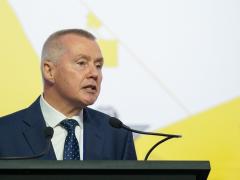
Monwabisi Kalawe,
SAA group ceo, said the
implementation of the airline’s
long-term turnaround strategy
(LTTS) had achieved a cost
compression of R220 million.
The airline cancelled its Kigali
route in December and will
cut its Buenos Aires route in
March. The airline announced
last year that all its long-haul
flights were loss making;
however it had to retain
routes that were of strategic
importance to its shareholder,
government, such as the route
to Beijing.
Malusi Gigaba, minister of
public enterprises said that
negotiations were under way
with the Chinese government
to secure a better landing
time for the Beijing route,
which would help bring it into
profitability.
The acquisition of fuelefficient
wide-body aircraft for
the carrier’s long-haul routes
is key to achieving profitability.
Malusi said that while the
Treasury had extended the
airline’s R5 million loan, it
had not approved the cash
injection required for the
wide-body fleet renewal. He
said he was dissatisfied with
an initial proposal for fleet
acquisition because it failed
to demonstrate compliance
with the required policies of
infrastructural development
and localisation.
According to Malusi, a task
team would prepare a longterm
funding model as well as
an aviation plan, which would
be presented to Treasury
before a decision was made
on the form or level of funding
the state would offer to
support the airline. He would
not put a number to the
figure, saying he did not want
to jeopardise the negotiations
with Treasury. However,
Monwabisi said that, given
the cost of aircraft, they were
looking at millions.
Monwabisi said the aviation
plan would take into account
issues including the required
transit visa, which threatened
SAA’s position as it made OR
Tambo an unattractive transit
airport. He added that the
airline was looking to establish
a West African hub but
stressed that OR Tambo would
remain the airline’s primary
hub. He would not respond
to speculation that the hub
would be based in Nigeria,
saying only that there were
a number of countries under
consideration.