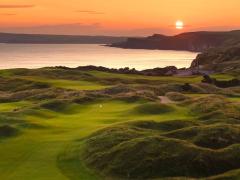
The land of a thousand hills
OFTEN associated with
either the graceful
mountain gorillas that
inhabit the north-western
parts of the country or the
devastating genocide that
saw over a million people
killed in roughly 100 days,
Rwanda is a culturally rich and
beautifully lush country that
offers visitors far more than
expected.
Modern skyscrapers
together with clean and wellmaintained
roads characterise
the capital, Kigali, which is
bustling with activity and
new developments. A new
convention centre is expected
to open later this year and
both Marriott and Radisson
are building hotels in the city.
Serena Hotels operates two
hotels in the country, one
in Kigali and one on Lake
Kivu in Gisenyi, which can
be packaged together with
transfers, allowing guests to
include both the mountain
gorillas and the Genocide
Museum as part of their stay.
The road between Kigali and
Gisenyi winds around the hills
that characterise Rwanda’s
countryside. The three-hour
transfer is punctuated by a
stop at Hotel Muhabura, which
is famous for accommodating
gorilla researcher, Dian
Fossey, when she came
down from her camp. Here
travellers can freshen up and
enjoy snacks and drinks – the
local beer, Mützig, is highly
recommended
See the mountain gorillas
There are roughly 10
families of gorillas living
in Parc National des
Volcans, or Volcanoes
National Park, in northwestern
Rwanda. Seeing
the mountain gorillas
is at the top of many
travellers’ wish lists, but
the adventure comes
with a significant price
tag. A permit to see the
gorillas costs US$750
(R9 330). William
Gateja, a local tour
guide, says clients are
guaranteed to see the
gorillas, although getting
to them often requires
a couple of hours of
trekking. Visitors spend
an hour with the majestic
animals in their natural
habitat.
A visit to the Genocide Museum
While some travellers
may be hesitant about
visiting the Genocide
Museum, it is a
significant stepping
stone to understanding
the country’s history.
On arrival, visitors are
greeted by friendly staff
and directed to a small
theatre to see a short
film. From there, guests
can use audio devices to
direct them on the tour
of the museum. The tour
traces Rwanda’s history
from before the genocide,
through the atrocity
and beyond, looking at
how the country has
recovered. The audio
tour provides additional
information and,
because it plays at
intervals that visitors set
themselves, it lets them
explore the museum at
their own pace.
Off the beaten track...
Enjoy sundowners on Lake Kivu
Guests at Lake Kivu Serena Hotel
can set out on the hotel’s boat for
a cruise to watch the sun set over
Lake Kivu. The lake is over 2 700
square kilometres and stretches as
far as the eye can see. It lies on
the border between Rwanda and the
DRC, and the city of Goma can be
seen from the Rwandan side. The
boat accommodates 17 passengers
and cold cuts and drinks can be
prepared aboard the boat.
RwandAir operates daily flights
between Johannesburg and Kigali.
Flights depart 07h15 on Tuesdays,
Thursdays and Saturdays and at
08h30 on Mondays, Wednesdays,
Fridays and Sundays. All return
flights depart Kigali at 20h30.
Escape to Akagera
Akagera National Park is in the
northeast of the country and takes its
name from the Akagera River, which
feeds the numerous lakes in the park.
Lions were recently re-introduced to
the park, which is managed by African
Parks and the Rwanda Development
Board. There are also plans to
reintroduce Black rhino. The park
covers over 1 000 square kilometres
and is home to elephant, buffalo
and zebra as well as waterbuck and
Roan antelope. Primates including
Vervet monkeys, Blue monkeys,
bushbabies and baboons are also
found in the park.
Scale Rwanda’s highest volcano
At 4 507 metres above sea level,
Mount Karisimbi is Rwanda’s
tallest volcano and the climb
requires travellers to take part in
a two-day trek. Hikers depart early
in the morning, overnighting along
the way. On the second day,
hikers summit the volcano and
are treated to views of Rwanda’s
rolling hills as well as those of
neighbouring Democratic Republic
of the Congo.
Visit the ‘healing’ hot springs
The hot springs on the outskirts
of Gisenyi are said to have healing
powers, while the water is hot
enough to cook small fish. Local
children are keen to wet visitors’
arms with the water and they’re also
inclined to request a small donation.
Therefore, it’s recommended
that visits to the hot springs are
accompanied by a responsible
operator. William suggests that
visitors offer gifts of stationery and
not money so that the children are
not encouraged to beg.